The Book

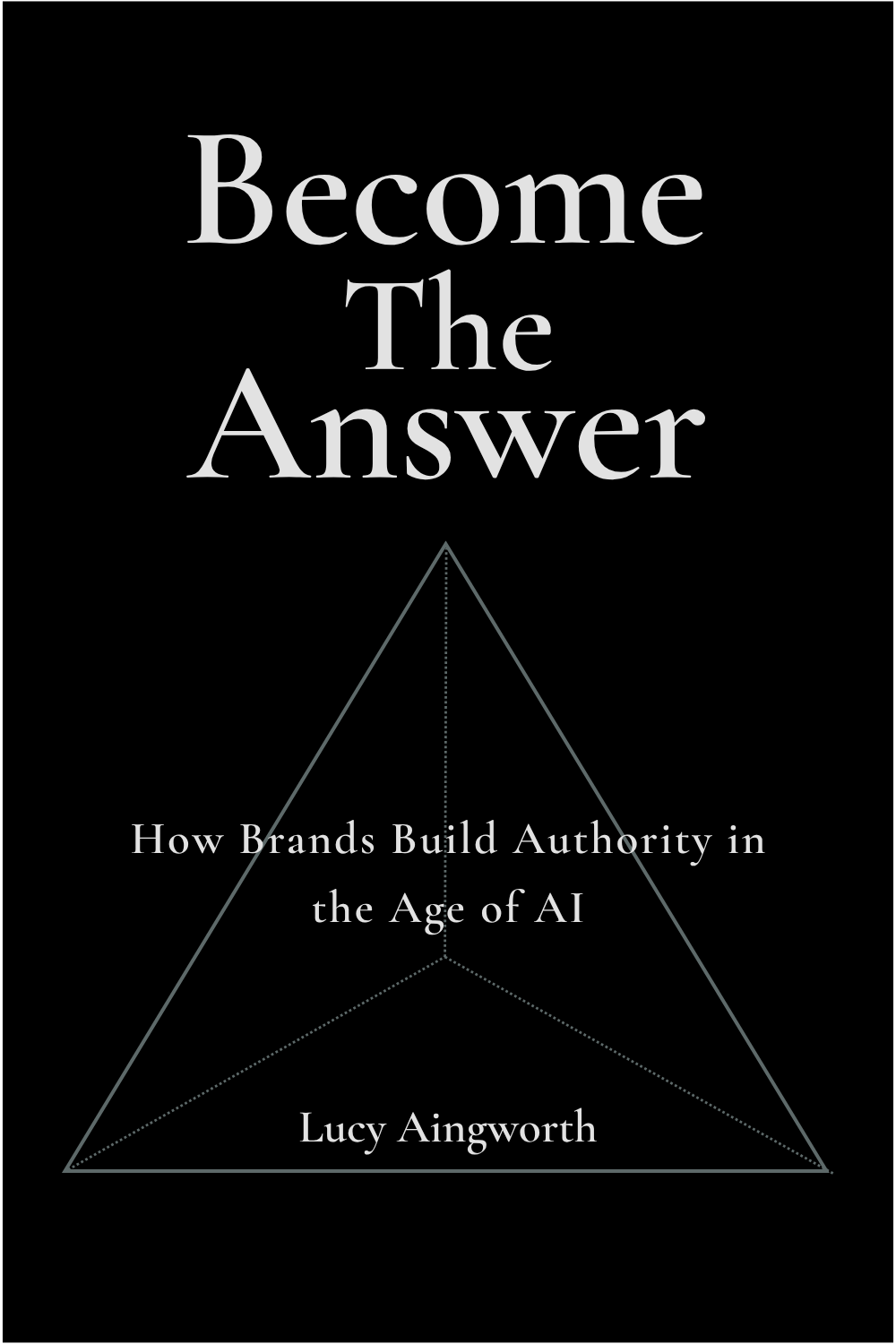
Become the Answer.

How Brands Build Authority in the Age of AI

Recognition has never been the same as visibility. Somewhere along the way we crossed those wires and started treating them as the same thing. This book is built around that realization and what it changes once you see it clearly.

For founders, marketers, and leaders in knowledge-based businesses who can feel that something has shifted but cannot yet name what it is or what it means for how they should keep operating.

Author Lucy Aingworth
Published 2026
Chapters 14 + Intro
Publisher Aingworth
The Central Argument
"Authority is no longer published.
Authority is earned.
The writing has been on the wall for years. AI just made it impossible to look the other way any longer."

Become the Answer, Chapter 4

The shift from navigation to interpretation changed everything. Search engines ranked pages. AI systems form answers. The organizations that appear in those answers are not the ones that optimized hardest. They are the ones that built genuine, structural authority over time.

The gap between being cited and not being cited is not a visibility gap anymore. It is a commercial gap, measurable in pipeline and revenue, and it compounds in the same direction every month.

This book maps that shift, names the forces driving it, and gives founders, CMOs, and executives a practical framework for building the kind of authority that holds up when the system is an AI rather than a search engine.

It does not gloss over the uncomfortable parts. AI systems are not neutral arbiters. They are products built by companies with commercial incentives. Earned Authority does not make you immune to that reality. But it means your presence is not entirely dependent on an arrangement that can shift or price you out.
See Where You Stand First
The Frameworks

Six ideas the book introduces.

These are the core concepts developed across the fourteen chapters. Each one has a specific meaning within the framework.

The Core Framework

The Recognition Triangle

Three dimensions that AI systems evaluate when forming a picture of a brand's authority: Clarity, Credibility, and Earned Authority. Each can be assessed independently. All three must work together for the machine to form a confident answer that includes you. Strength in one or two without the third creates a partial picture. Partial pictures don't get cited.

The Shift

The Recognition Economy

The economic model that replaces the visibility economy. In the visibility economy, reach and ranking determined commercial outcomes. In the recognition economy, it is the depth and breadth of independent validation of your authority that determines whether you appear in AI-mediated discovery at all. The rules changed. Most organizations are still playing the old game.

The Threat

The Machine Gatekeeper

What happens when an AI system evaluates a category and decides which organizations to include in its answer. Unlike previous gatekeepers, it operates upstream of everything you can measure. When it excludes your brand, no signal fires. No ranking drops. No traffic declines. Opportunities simply never materialize. You cannot respond to a loss you cannot see.

The Hidden Cost

Authority Debt

The compounding cost of years of investment in owned content and visibility without equivalent investment in the independent ecosystem signals that give that content its weight. Authority Debt is uncomfortable to acknowledge because it means genuine effort has not produced the recognition it should have. The debt exists. It can be identified. And it can be addressed. But not without first understanding what it costs.

The Method

The Authority Method

A five-stage system for building Earned Authority deliberately: Diagnose, Define, Build, Distribute, and Refine. Each stage has specific activities, specific outcomes, and a specific sequence. Skipping stages produces partial results. The method is designed to produce authority signals that compound over time rather than requiring constant reinvestment to maintain.

What AI Reads

The Composite Picture

The aggregate picture an AI system assembles of your brand from independent signals across the digital ecosystem. It is not what you say about yourself. It is what the room says when you are not standing there. Many organizations discover their Composite Picture is either too thin to generate confidence, or actively wrong because of inconsistent signals accumulated over years. Both problems have different solutions.

Contents

Fourteen chapters.
One complete argument.

Intro
The Moment That Changes Everything

How one Tuesday afternoon became the lens for everything that follows.

01
The Day Visibility Stopped Being Enough

The gap between recognition and visibility and why it matters more now than it ever has.

02
From Navigation to Interpretation

How search evolved from directories to engines to AI interpreters and what changed with each shift.

03
The Machine Gatekeeper

The gatekeeper that operates upstream of everything you can measure and the specific danger of its invisibility.

04
Authority Is No Longer Published, It Is Earned

The three layers of Earned Authority and how Authority Debt accumulates silently.

05
What Nobody Is Telling You

The uncomfortable truths about AI systems, commercial arrangements, and what they mean for your brand's position.

06
The Recognition Economy

The new economic model replacing visibility as the primary driver of commercial outcomes.

07
The Authority Method

The five-stage framework: Diagnose, Define, Build, Distribute, Refine.

08
The Recognition Triangle

Clarity, Credibility, and Earned Authority mapped as a diagnostic and strategic framework.

09
Diagnose

How to assess your current position across all three dimensions of the Recognition Triangle.

10
Define

Establishing the clarity your brand needs before any building begins.

11
Build

The specific activities that generate Earned Authority across the three layers.

12
Distribute and Refine

How to extend your authority signals and keep the system calibrated over time.

13
The Agentic Future

How AI agents, fragmented global knowledge architectures, and agentic discovery change the stakes.

14
Becoming Impossible to Overlook

What it looks like when the framework works and what comes next.

I did not set out to write a book about artificial intelligence. I set out to understand something that had been bothering me for years: why do some brands become the name people reach for without thinking, while others stay invisible, even when they are doing everything right according to the playbook?

Lucy Aingworth, Author's Note, Become the Answer
Key Terms

The framework has
its own vocabulary.

These terms carry specific meaning within Become the Answer. Where they appear, they refer to the framework concepts, not their general everyday sense. Click any term to expand.

The compounding hidden cost of investing in owned content and visibility while neglecting the independent ecosystem validation that gives that content its weight. It accumulates silently and grows faster than most organizations realize.

Chapter 4

The five-stage operational process for building recognition deliberately: Diagnose, Define, Build, Distribute, and Refine. The method translates the framework's conditions into structured, sequenced work.

Chapters 9 to 13

The third tier of Earned Authority, formed through organic conversation about an organization in the communities and platforms where practitioners gather independently. It carries less individual weight than the Structural and Expert Layers but matters significantly in aggregate.

Chapter 8

The picture an AI system assembles of an organization from the full pattern of signals that exist about it across the digital ecosystem, including everything beyond the organization's own channels. This is what the machine actually reads when forming its view of who deserves to be trusted.

Chapter 5

Independent validation from sources with no commercial reason to agree. Not what an organization claims about itself but what the ecosystem confirms about it across the Structural, Expert, and Community Layers. The condition that determines whether the machine includes or excludes an organization from its answers.

Chapters 4 and 8

The second tier of Earned Authority, formed through citation and reference by independent experts, analysts, journalists, academics, and respected practitioners. It carries significant weight because independent experts have no obligation to mention an organization. When they do, the machine registers it differently from anything the organization published itself.

Chapter 8

Generative Engine Optimization. The practice of structuring, formatting, and positioning intellectual assets so that AI systems can read, retrieve, and attribute them with confidence. GEO amplifies genuine Earned Authority. It does not create it.

Chapter 11

The process by which AI systems form a shortlist of credible organizations before any human becomes involved in a buying decision. It operates upstream of everything organizations can currently measure, which is what makes its commercial consequences so difficult to detect until they are already significant.

Chapter 3

The competitive environment in which recognition, not visibility, is the primary currency of digital influence. The organizations that win are not the loudest or the most visible but the most clearly understood, most consistently validated, and most widely confirmed as the authority in their specific territory.

Chapter 6

The framework describing the three conditions that must be simultaneously present for recognition to form: Clarity, Credibility, and Earned Authority. Each corner is equally necessary. Recognition sits at the center and emerges only when all three are aligned.

Chapter 8

The six diagnostic patterns that describe how an organization's Recognition Triangle currently looks: the Promising Claim, the Hidden Expert, the Validated Generalist, the Strong Foundation, the Recognized Authority, and the Decaying Authority. Each pattern points directly to where investment needs to go first.

Chapter 8

The highest-weighted tier of Earned Authority, formed through accurate and substantive representation in the formal knowledge systems that AI relies on most heavily: Wikipedia, industry databases, knowledge graphs, and structured data sources. It is the hardest tier to fake and the most durable once built.

Chapter 8
Get the Book

The brands that win the AI era don't chase attention. They become the answer.

Available on Amazon in most major markets. Paperback and Kindle editions. South Africa availability is limited on Amazon but the book is accessible via international Amazon stores with delivery options.