A four hundred item technical audit is a way of looking thorough. A much smaller body of work decides whether a machine can understand what your business is at all. These are not the same list, and only one of them is worth your budget.
Lucy Aingworth
AI Visibility Consultant
Published 8 min read
The short answer
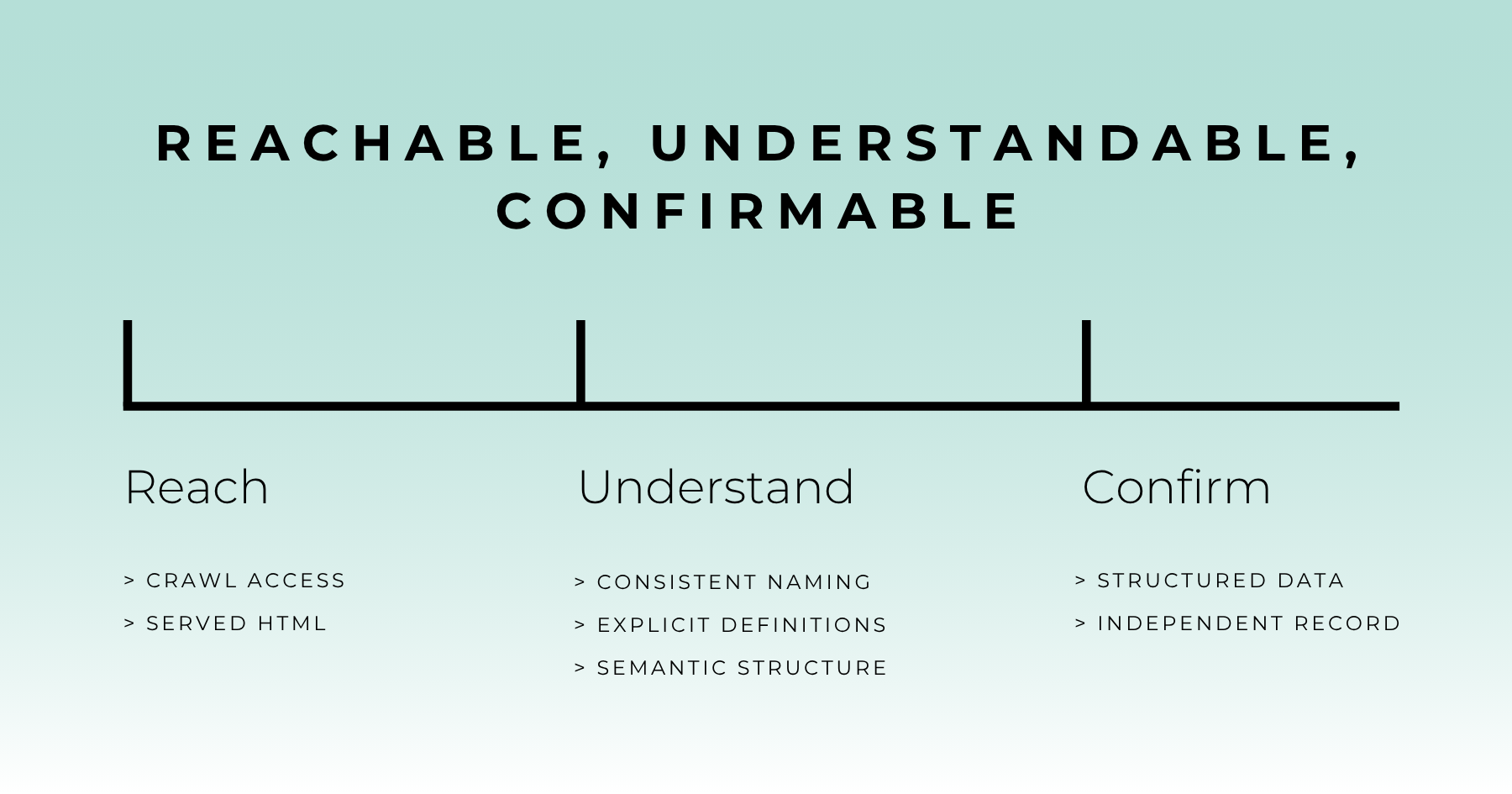
The useful test for any piece of technical work is no longer whether it improves a score, but whether it changes what a machine can know about your business. That reduces to three questions. Can the system reach the information, meaning crawl access and content present in the served HTML. Can it understand what the information means, meaning consistent naming, explicit definitions and semantic structure. Can it confirm the information elsewhere, meaning structured data that links to independent records and agrees with the prose beside it. Work that answers one of those three earns its budget. Most of the traditional checklist does not.
Key takeaways
Ranking work is incremental and rewards thoroughness. Comprehension is closer to binary, so a hundred small fixes do not accumulate into it.
AI crawlers are distinct user agents and are frequently blocked by robots rules nobody has revisited in years.
Content assembled by script or revealed by animation can be fully visible to a person and effectively absent to a machine.
Structured data that contradicts the prose on the same page is worse than no structured data at all.
A scope that names its own exclusions is far harder to argue with than one that quietly omits them.
Search Engine Land published a prioritization framework this month arguing that a subset of technical work delivers measurable value while much of the traditional checklist can safely be deferred. That has been quietly true for years. What has changed is the criterion for telling the two apart, and the new criterion is far less forgiving than the old one.
Why was the old checklist built for a different machine?
The traditional checklist was built for a crawler ranking pages. Its logic was incremental: each fix nudged a score, and the accumulation of small improvements produced a slightly better position. That model rewarded thoroughness, which is why the industry standardized on long audits. It also produced sharply diminishing returns, which everyone noticed and nobody wanted to say.
An AI system is not ranking your page against nine others. It is trying to decide what you are, and whether it can say so without being wrong. That is a comprehension problem rather than a scoring problem, and comprehension does not accumulate in small increments. Either the machine can state what you do and confirm it, or it cannot, and a hundred minor fixes will not move it across that line.
Structural Layer
The Structural Layer is the formal record an AI system treats as fact: knowledge graphs, reference databases, registries, and structured data. It is the layer you have the most direct control over, and the one most businesses have left in the worst condition.
What is the new test for technical work?
Three questions, applied to any proposed task. Can the machine reach the information. Can it understand what the information means. Can it confirm the information somewhere it does not control. Anything that changes the answer to one of those is worth doing. Anything that does not is competing for budget against work that does.
Can it be reached?
Nothing else matters if the content is unreachable. That means crawl access is deliberately granted rather than accidentally denied, which is a live problem now that AI crawlers are distinct from search crawlers and are frequently blocked by rules nobody has revisited. It also means the substance of the page exists in the served HTML. Content assembled by script after load, or carried entirely by an animation, may be perfectly visible to a person and effectively absent to a machine. If the sentence that explains what you do only appears once something has faded in, it does not exist.
Can it be understood?
Understanding is where the real gains sit, and it is mostly not code. It is whether your business is described the same way everywhere, whether the concept you own is named consistently rather than paraphrased differently on each page, and whether the important claims are stated in plain declarative sentences rather than implied through design. Semantic markup and descriptive headings help because they tell the machine which parts of the page are the argument and which are the furniture. Defining your key terms explicitly on the page helps most of all, because it removes the machine's need to infer.
Can it be confirmed?
The third question is the one traditional audits ignore entirely. A machine that understands your claim then looks for agreement. Structured data describing your organization, your people and your services matters here, and it matters much more when it links out to the independent records that confirm it. Structured data that contradicts the prose on the same page is worse than none, because it introduces exactly the inconsistency that makes a Composite Picture wobble.
Reachable, understandable, confirmable
The question is not whether the page is optimized. It is whether the machine can say what you are without guessing.
The framework behind this argument
The named ideas from Become the Answer, set out in full.
Most of the rest. Micro-optimization of individual page elements, exhaustive image compression on pages nobody reaches, chasing the last few points of a synthetic performance score, restructuring internal links for marginal equity flow. None of it is wrong. All of it is work that changes a number without changing whether the machine can describe you, and in a fixed budget it is competing directly against work that does.
Work
Which question it answers
Priority
AI crawler access review
Reach
Do first
Content in served HTML
Reach
Do first
Consistent naming and definitions
Understand
Do first
Organization and service schema
Confirm
Do next
Links to independent records
Confirm
Do next
Image compression on low-traffic pages
None
Defer
Synthetic score chasing
None
Defer
The exception is anything that affects reachability. A page slow enough to time out is a crawl problem wearing a performance costume, and that belongs in the first category. The distinction is not speed versus structure. It is whether the fix changes what the machine can know.
How should you scope this with a client?
There is a commercial point buried in this. If you are paying an agency, or you are the agency, the long checklist has one obvious appeal: it looks like value. A short scope looks like less work even when it is worth considerably more, which is why so many engagements default to a thoroughness nobody benefits from.
The way through is to be explicit. Write down what the work covers and, in the same document, what it deliberately leaves alone and why. A scope that names its own exclusions is far harder to argue with than one that quietly omits them, and it converts the uncomfortable question of why the audit is short into a demonstration that you know which parts matter. That is not a defensive document. It is the clearest proof of judgment you can put in front of a buyer.
Comprehension is the whole game now. A business a machine can reach, understand and confirm will be described accurately even when it is not the loudest name in the field. A business that fails any one of those three will be described vaguely or not at all, no matter how many items were ticked off on the way. That matters more than ever as AI agents begin selecting suppliers on attributes they can verify.
A note on the evidence in this article: the three-question framing is a prioritization heuristic drawn from published analysis and from practice, not a measured ranking of factors. There is no study that isolates crawl access, entity clarity and structured data cleanly enough to weight them against each other. What can be said with confidence is that a system unable to reach, parse or confirm a claim cannot act on it, and that most items on a traditional audit affect none of those three.
Frequently asked questions
Which technical SEO tasks actually matter for AI visibility?
The ones that change what a machine can know about you rather than the ones that move a score. In practice that means crawl access for AI crawlers, content present in the served HTML rather than assembled by script, consistent naming and explicit on-page definitions, semantic structure, and structured data that links out to independent records confirming it. Most other checklist items can be deferred without measurable loss.
Why is comprehension different from ranking?
Ranking is incremental. Each small fix nudges a position, so thoroughness is rewarded. Comprehension is closer to binary. Either a system can state what your business is and confirm it, or it cannot, and a hundred minor improvements will not move it across that line. That difference is why long technical audits produce diminishing returns in an AI-first index.
Do AI crawlers need separate permission from search crawlers?
Often yes. AI crawlers are distinct user agents from traditional search crawlers, and many sites block them through robots rules written years ago or added by default by a platform. Crawl access should be a deliberate decision that someone has reviewed recently, not an accident inherited from a previous configuration.
Does schema markup improve AI recommendations?
It improves retrieval rather than recommendation. Controlled testing has found meaningful gains in how well AI systems can extract information from a page that uses structured data. That helps a machine read what is already there. It does not on its own create the independent evidence that decides whether a business is worth surfacing, and structured data that contradicts the prose on the same page does active harm.
Can content hidden behind animation be read by AI systems?
Often not. Content assembled by script after page load, or revealed only through an animation, may be perfectly visible to a person and effectively absent to a machine. If the sentence that explains what your business does only appears once something has faded in, it may not exist as far as the system is concerned. Anything load-bearing should be present in the served HTML.
What technical work can safely be deferred?
Micro-optimization of individual page elements, exhaustive image compression on low-traffic pages, chasing the last few points of a synthetic performance score, and restructuring internal links for marginal equity flow. None of it is wrong. All of it changes a number without changing what a machine can know, and in a fixed budget it competes directly against work that does. The exception is anything affecting whether a page can be reached at all.
Lucy Aingworth is an AI visibility strategist and brand authority consultant, and the author of Become the Answer. She helps founders and CMOs build the authority that AI search actually cites. More about Lucy
Where to start
Find out what a machine can actually say about you.
The Recognition Diagnostic shows you where your record breaks down, and whether the fix is technical, editorial, or something further upstream.