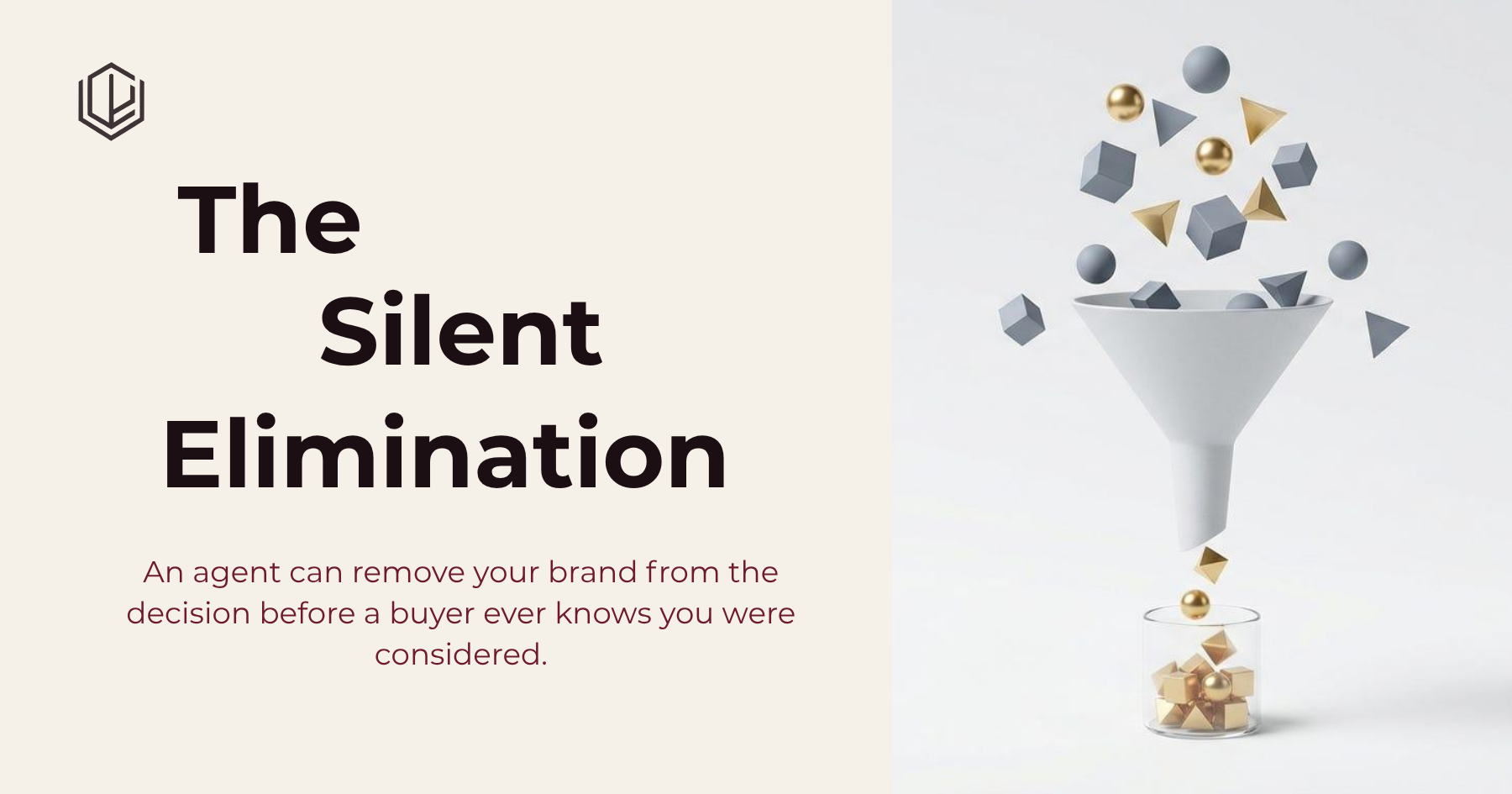
When the gatekeeper stops answering and starts acting
Agentic AI does not produce an answer for a person to read. It completes the task, and it narrows the field on the way. Selection now happens at a step no human ever sees.
Lucy Aingworth
AI Visibility Consultant
Published 7 min read
The short answer
Agentic AI tiers complete multi-step tasks rather than returning answers for people to read. When an agent shortlists suppliers, it searches, compares and discards candidates inside a process nobody reviews. That creates a failure mode distinct from being uncited: a brand can be eliminated at an intermediate step with no impression, no click, and no record of the decision anywhere. Passing that filter depends on attributes an agent can confirm rather than attributes it merely reads, which puts unusual weight on the Structural Layer and on independent corroboration.
Key takeaways
OpenAI launched an agentic tier this month that takes files, runs multi-step tasks, checks its own output, and returns only when a decision is needed.
When a system answers, brand names and sources are visible. When an agent acts, the shortlisting is compressed into a result nobody audits.
Elimination at an intermediate step produces no impression, no click and no citation, so it is invisible in every analytics tool currently sold.
Agents prefer attributes they can confirm over attributes they can read, which makes ambiguity a reason for exclusion rather than a minor weakness.
Adoption is uneven across markets, and the work required takes months, so the gap between the two is the entire opportunity.
OpenAI launched an agentic tier this month. It takes files, executes multi-step tasks, checks its own output, and comes back to the user only when it needs a decision made. Most of the coverage treated this as a productivity story, which it is. It is also the most consequential thing to happen to brand discovery since AI answers arrived, and almost nobody is discussing it in those terms.
The reason is that the change is easy to miss. Nothing about how a brand becomes visible has been reversed. What has changed is who is reading the intermediate steps, and the answer is increasingly nobody.
What changes when AI acts instead of answers?
When an AI system answers a question, the output is built for a human. Names appear. Sources are listed. The reasoning is at least partially exposed, which is why a brand can screenshot its own citation and treat it as evidence of visibility. The Machine Gatekeeper makes a recommendation, and a person evaluates it.
When an agent performs a task, the output is built for completion. Ask it to find and shortlist three suitable firms and it will search, read, compare, discard, and return a short list with a justification. The searching and the discarding happened. The record of what was considered and rejected exists only inside the process, compressed into a result nobody audits. The person sees three names and a reason. They do not see the forty that were dropped, and neither do you.
The Machine Gatekeeper is the AI layer that now sits between your buyer and your brand, reading the wider record and deciding who is safe to put forward. In its agentic form it no longer presents that decision for review. It acts on it.
Why is this failure mode invisible?
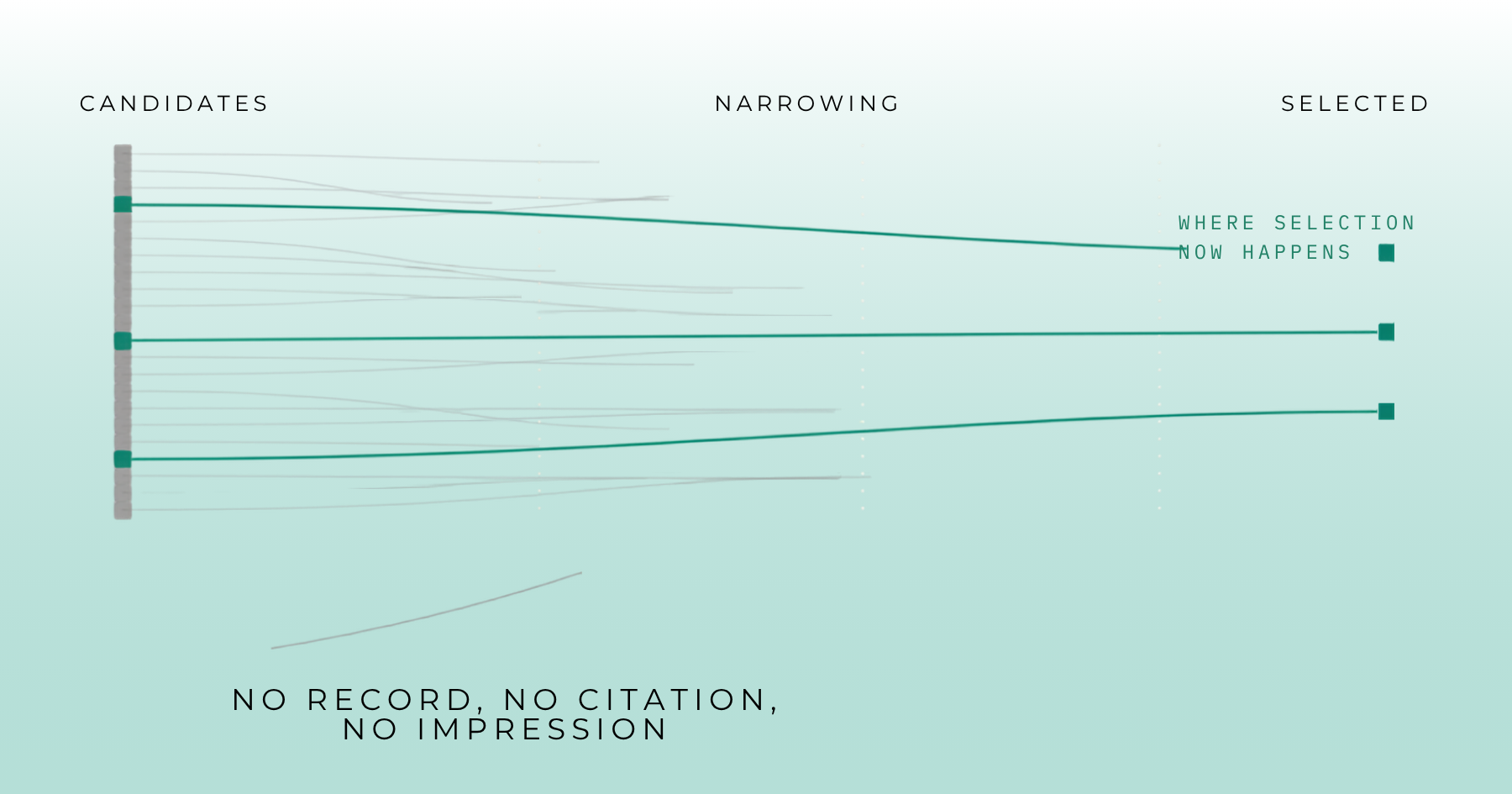
Until now, the way to lose in AI discovery was to be absent from the answer. That failure is at least observable. You can run the query, see that you are missing, and know you have a problem. Agentic flows create a second failure that leaves no trace at all: elimination at an intermediate step, in a process that never surfaces, for a reason nobody records.
You can now be removed from a decision that no human ever consciously made.
There is no impression, no click, no citation, and no screenshot. Your analytics show nothing, because nothing happened. This is not a hypothetical degradation of an existing problem. It is a different problem, and it will be invisible in every reporting tool currently sold in this market.
Where selection now happens
What does an agent need from your business?
An agent narrowing a field behaves differently from a person browsing one. It is optimizing for a choice it can defend, which means it prefers attributes it can confirm over attributes it merely reads. Where a human might forgive a vague service description because the site looked impressive, an agent treats ambiguity as a reason to move on. There is always another candidate whose details resolve cleanly.
That puts unusual weight on the Structural Layer. The formal, machine-readable record of what you do, what you are qualified to do, what you are called, and where that name is confirmed stops being technical hygiene and becomes the filter you either pass or fail. A firm whose registered name differs from its trading name, whose service lines are described only in marketing prose, and whose credentials appear nowhere a machine can check is not badly presented. It is unselectable.
Structural Layer
The Structural Layer is the formal record an AI system treats as fact: registries, knowledge graphs, reference databases and structured data. It is the layer a business has the most direct control over, and the one an agent leans on hardest when it needs a decision it can justify.
The verification step that human buyers perform does not disappear here either. It moves inside the process, and it gets stricter. An agent checking your claims will do it faster, more literally, and without the benefit of the doubt. Independent corroboration, the substance of Earned Authority, matters more in an agentic flow rather than less, because the agent has no other basis for confidence and no capacity to be impressed. I have written separately about what happens during that verification step when a human runs it.
The framework behind this argument
The named ideas from Become the Answer, set out in full.
Adoption of agentic flows is uneven and will stay uneven for several quarters. Some markets are already running procurement through them. Others have barely encountered the idea. That gap is the entire opportunity, because the work required takes months and the moment it becomes obviously necessary is the moment it stops being an advantage.
The businesses that will be selected by agents in two years are the ones whose formal record is unambiguous and whose independent corroboration is already in place, and neither can be assembled quickly. This is one of the rare cases where being early is not a marginal edge. It is the whole thing.
How should you test for this?
The practical change is small and immediate. Most businesses test their AI visibility by asking a chatbot a question and reading the answer. That measures the previous era. Test the current one by giving an agent a task instead: find and shortlist three firms who can do the specific thing you do, then explain the shortlist.
Run it for yourself and for two competitors. Note who survives to the shortlist, and then ask the agent directly why the others were excluded. The answer will be more useful than any dashboard, because it is the machine describing, in plain terms, the point at which your record stopped being good enough to bet on.
A note on the evidence in this article: agentic selection behavior is new enough that there is no published body of research on how these systems shortlist suppliers, and the companies building them have not documented it. What is described here is inference from how the tools are designed to operate and from repeated hands-on testing, not a measured effect. Treat the direction as well founded and the specifics as provisional, and test it against your own category rather than taking my word for it.
Frequently asked questions
What is agentic AI?
Agentic AI refers to systems that complete multi-step tasks rather than returning an answer for a person to read. An agent takes an instruction, searches, compares, discards options, checks its own output, and returns only a finished result or a decision point. The intermediate reasoning happens inside the process and is usually never reviewed by a human.
How does agentic AI change brand discovery?
When an AI system answers a question, brand names and sources appear on screen for a person to evaluate. When an agent performs a task, it narrows a field of candidates internally and returns a short list. The selection still happened, but the record of what was considered and rejected exists only inside the process. Brands can therefore be eliminated from a decision without any human ever seeing that they were considered.
Why is agentic elimination invisible in analytics?
Because nothing measurable happens. There is no impression, no click, no citation and no referral. A brand dropped at an intermediate step generates no event in any analytics platform, so the loss cannot be observed, counted, or attributed. This is different from being absent from an AI answer, which can at least be detected by running the query.
What do AI agents need from a business to select it?
Attributes they can confirm rather than attributes they merely read. That means an unambiguous registered and trading name, service lines described in plain declarative language rather than marketing prose, credentials and qualifications recorded somewhere machine-readable, and consistency between all of them. An agent optimizing for a defensible choice treats ambiguity as a reason to move on, because another candidate will resolve cleanly.
Does independent validation still matter for AI agents?
It matters more. An agent performing a verification check does it faster, more literally, and without giving any benefit of the doubt. It cannot be impressed by design or persuaded by tone, so independent corroboration is close to its only basis for confidence in a claim. Earned Authority carries more weight in an agentic flow than in a conversational one, not less.
How should a business test its visibility to AI agents?
Stop testing with prompts and start testing with tasks. Rather than asking a chatbot a question and reading the answer, give an agent a job: find and shortlist three firms that can do the specific thing you do, then explain the shortlist. Run it for your own business and two competitors, note who survives, then ask the agent directly why the others were excluded.
Lucy Aingworth is an AI visibility strategist and brand authority consultant, and the author of Become the Answer. She helps founders and CMOs build the authority that AI search actually cites. More about Lucy
Where to start
Find out whether an agent could choose you.
The Recognition Diagnostic shows you where your record is too ambiguous to survive a filter that never explains itself.