Most buyers have now asked an AI system for a recommendation. Almost none of them act on the answer without checking it somewhere else first. The gap between the mention and the decision is where brands are quietly lost.
Lucy Aingworth
AI Visibility Consultant
Published 8 min read
The short answer
Being named by an AI system is the entry ticket, not the outcome. BrightLocal's 2026 research found that almost half of consumers now use AI to find a local business, up from just 6 percent a year earlier, but only 18 percent felt ready to act on the answer without checking it somewhere else first. That verification step runs almost entirely on evidence a brand does not control: consistent naming across formal records, recent reviews, and independent third-party discussion. Clarity gets a brand mentioned. Credibility and Earned Authority decide whether the buyer acts.
Key takeaways
Almost half of consumers now use AI to find a local business, up from just 6 percent a year earlier.
Only 18 percent felt ready to act on the answer without checking it elsewhere, which means four in five run a verification step.
That check tests Credibility and Earned Authority, not the clarity work most GEO budgets are currently spent on.
A brand can win the citation and still lose the client, and nothing in its analytics will record the loss.
Because the check runs on independent evidence, it cannot be gamed, which makes it the most durable advantage available.
A figure published this month should change how every serious brand thinks about AI visibility. In BrightLocal's 2026 research, almost half of consumers said they had used an AI tool to find a local business, a share that has climbed from just 6 percent a year earlier. Adoption, in other words, has stopped being the interesting question. The interesting number is the other one. Only 18 percent felt ready to act on the AI's answer without verifying it elsewhere first.
Read those two numbers together and the entire conversation about AI visibility reframes itself. The market is currently selling a single promise: get mentioned by AI. That promise is not wrong, it is incomplete, because the mention is the beginning of your buyer's process rather than the end of it. Four out of five people who receive your name go looking for confirmation before they commit. What they find, or fail to find, decides the outcome.
Behavior
Share of consumers
What it tells you
Used AI to find a local business in 2026
~45%
The channel is real and already mainstream
Used it a year earlier, in 2025
6%
The shift happened in a single year
Ready to act without checking elsewhere
18%
The citation alone converts rarely
You can win the citation and still lose the client, and most brands have no idea it is happening, because the loss occurs somewhere they are not measuring.
Why is being mentioned only the entry ticket?
Getting named is a clarity problem. The Machine Gatekeeper can only recommend what it can describe, and it can only describe what it can read cleanly. Brands that are precise about the specific problem they solve, consistent in how they name it, and legible in their structured data get pulled into the answer. Brands that describe themselves in category language broad enough to fit a hundred competitors do not, because the machine has nothing distinct to hold onto.
That work matters, and it is where almost all current GEO effort is concentrated. The difficulty is that clarity is also the easiest corner to improve, which means it is the corner that gets commoditized first. Once every competent brand in your field is machine-legible, being mentioned stops being a differentiator and becomes the price of entry. The advantage moves to whatever happens next.
The Machine Gatekeeper is the AI layer that now sits between a buyer and a brand, reading the wider record and deciding which brands are safe to put forward. It does not weigh advertising spend or the polish of a homepage. It weighs whether the independent record makes a brand an obvious thing to recommend.
What happens after the AI names you?
Picture the 82 percent who do not act immediately. They have your name in front of them, given by a system they half trust, and they do the obvious thing. They search the brand directly. They look for a registered entity that matches the name they were given. They read reviews, and they notice how recent those reviews are. They look for someone independent discussing your work, ideally someone with no commercial reason to. The whole sequence takes ninety seconds and it functions as an audit.
Every one of those steps tests the two corners the market is not selling. Reviews, register entries, third-party coverage and consistent naming are Credibility. Independent voices discussing your thinking without being asked are Earned Authority. The AI supplied the candidate. The human verified it. And the verification runs entirely on evidence you do not control.
Clarity gets you mentioned. Credibility and Earned Authority get you chosen.
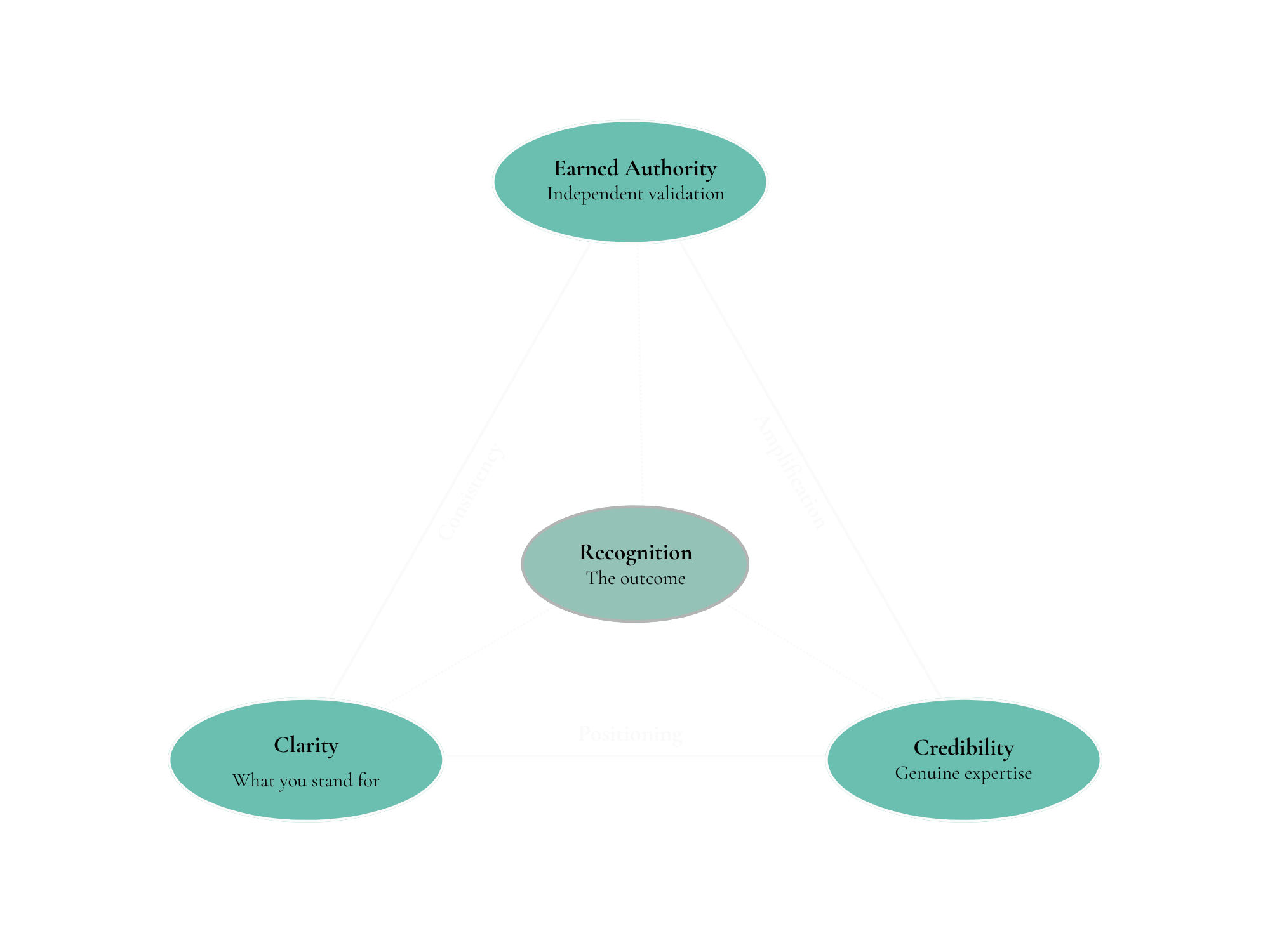
This is the Recognition Triangle doing exactly what it was built to describe, now with a number attached to it. Miss the clarity corner and you are never named. Satisfy clarity alone and you are named, then discarded ninety seconds later by a buyer who could not confirm anything you claimed. I set out the full framework in Become the Answer, and the three corners are covered in more depth on the frameworks page.
The Recognition Triangle defines the three conditions required for recognition to form: Clarity, whether the ecosystem knows what you stand for; Credibility, whether your expertise is independently verifiable; and Earned Authority, whether the wider ecosystem has confirmed it. Recognition sits at the center, held in place by all three at once.
The Recognition Triangle
What does a verification trail look like?
If the check decides the sale, then the check is the thing to design for. What a buyer follows during those ninety seconds is a trail, and most brands have never walked their own. It runs through four places. Whether your name is identical across every formal record, from the registry entry to the directory listing to your own site. Whether reviews exist, and whether the most recent one is from this year rather than three years ago. Whether anything independent corroborates the claim you make about yourself. And whether all of it agrees.
Agreement is the part people underestimate. A buyer who finds three descriptions of what you do, all slightly different, does not conclude that you are versatile. They conclude that they cannot tell what you are, and they return to the AI for the second name on the list. The same inconsistency that makes a human hesitate makes the machine hedge, which is why the two failures tend to arrive together.
Authority Debt is the gap between how confidently a brand describes itself and how little independent evidence exists to confirm it. The larger the gap, the faster a verification check collapses, and the more often a cited brand loses the decision to a less visible competitor with a cleaner record.
The framework behind this argument
Clarity, Credibility and Earned Authority, set out in full.
It would be easy to read that number as a problem. It is closer to a protection. If buyers acted on AI answers blindly, the winners would be whoever learned fastest to game the citation layer, and the advantage would last until the next model update erased it. Because a verification step exists, and because it runs on independent evidence, the brand with the deepest real record wins the check. That is an advantage nobody can copy in a quarter, and it does not evaporate when a system changes how it ranks.
It also explains a pattern that confuses a lot of capable firms. They appear in AI answers, they can screenshot it, and the enquiries do not follow. The visibility is real. The trail behind it is thin, so the buyer arrives at the check, finds an incomplete picture, and quietly chooses someone else. Nothing in their analytics records that decision, which is why it goes unfixed for years.
What should you do about it this week?
Run the trail yourself, as a stranger would. Ask an AI system the question your best client would have asked before they found you, and note whether you are named. Then stop treating that as the result and follow what happens next. Search your own brand name cold. Check whether your registered name, your listings and your site say the same thing. Look at your most recent review and its date. Search for your core idea and see whether anyone independent has ever discussed it without you in the room.
Wherever that sequence breaks is your real problem, and it is almost never the one you were about to spend money on. Every competitor in your field is currently selling the promise of getting mentioned by AI. The more valuable promise, and the harder one to fake, is surviving the check that happens immediately afterwards.
A note on the evidence in this article: the BrightLocal figures describe self-reported consumer behavior at a point in time, and self-reported behavior tends to overstate deliberation. The direction of the finding is well supported across several 2026 surveys, but treat the precise percentages as a reliable signal of the gap rather than a fixed constant. The argument does not depend on the exact numbers, only on the fact that the verification step exists and most buyers take it.
Frequently asked questions
Is being mentioned by AI enough to win the customer?
No. BrightLocal's 2026 research found that while almost half of consumers now use AI to find a local business, up from 6 percent a year earlier, only 18 percent felt ready to act on the AI's recommendation without checking it elsewhere first. Being named puts a brand into consideration. What the buyer finds during the verification step decides whether they act.
What is a verification trail?
A verification trail is the short sequence of checks a buyer runs after an AI system names a brand. It typically includes searching the brand name directly, looking for a registered entity that matches, reading reviews and noting how recent they are, and looking for independent third-party discussion of the business. The trail usually takes under two minutes and functions as an informal audit of the brand's claims.
Why do some brands appear in AI answers but get no enquiries?
Because visibility and verification are separate problems. A brand can be clear enough for an AI system to name it while having a thin independent record behind it. The buyer receives the name, runs the check, finds nothing that confirms the claims, and quietly chooses a competitor. Nothing in the brand's analytics records that decision, which is why the problem often goes undiagnosed for years.
What is Authority Debt?
Authority Debt is the gap between how confidently a brand describes itself and how little independent evidence exists to confirm it. The larger the gap, the faster a verification check collapses, and the more often a cited brand loses the decision to a less visible competitor with a cleaner and more consistent record.
How does the Recognition Triangle apply to AI citations?
Clarity determines whether an AI system can describe a brand well enough to name it at all. Credibility and Earned Authority determine whether the buyer's verification check succeeds afterwards. A brand strong only in Clarity gets mentioned and then discarded. A brand strong in all three gets mentioned and confirmed, which is what converts.
How can I test my own verification trail?
Ask an AI system the question your best client would have asked before they found you, and note whether you are named. Then follow what a buyer would do next: search your brand name cold, check whether your registered name, directory listings and website all describe you the same way, look at the date of your most recent review, and search for your core idea to see whether anyone independent has discussed it. Wherever that sequence breaks is the real problem.
Lucy Aingworth is an AI visibility strategist and brand authority consultant, and the author of Become the Answer. She helps founders and CMOs build the authority that AI search actually cites. More about Lucy
Where to start
Find out where your trail breaks.
The Recognition Diagnostic shows you which of the six patterns applies to your brand right now, and which corner of the triangle is costing you the decision.