Every dashboard in this category reports a single number. Personalized AI answers make that number a description of one person's experience, presented as though it described everyone's.
Lucy Aingworth
AI Visibility Consultant
Published 8 min read
The short answer
AI answers are personalized, shaped by entity recognition, session context and multimodal signals rather than a fixed ranking position. That makes position a property of the interaction between a brand and one particular person, not a stable property of the brand. A single visibility score is therefore one draw from a distribution, reported with a confidence the data does not support. The honest replacement is three figures: a median, a spread, and a floor. The spread is the most diagnostic of the three, because inconsistency is the system telling you its record of you disagrees with itself.
Key takeaways
Personalization means two buyers with identical needs can receive different brand names, and neither result is an error.
A single visibility percentage describes one sample, not a stable position, and cannot be compared reliably across time.
Report a median for the typical outcome, a spread for stability, and a floor for the least favorable phrasing.
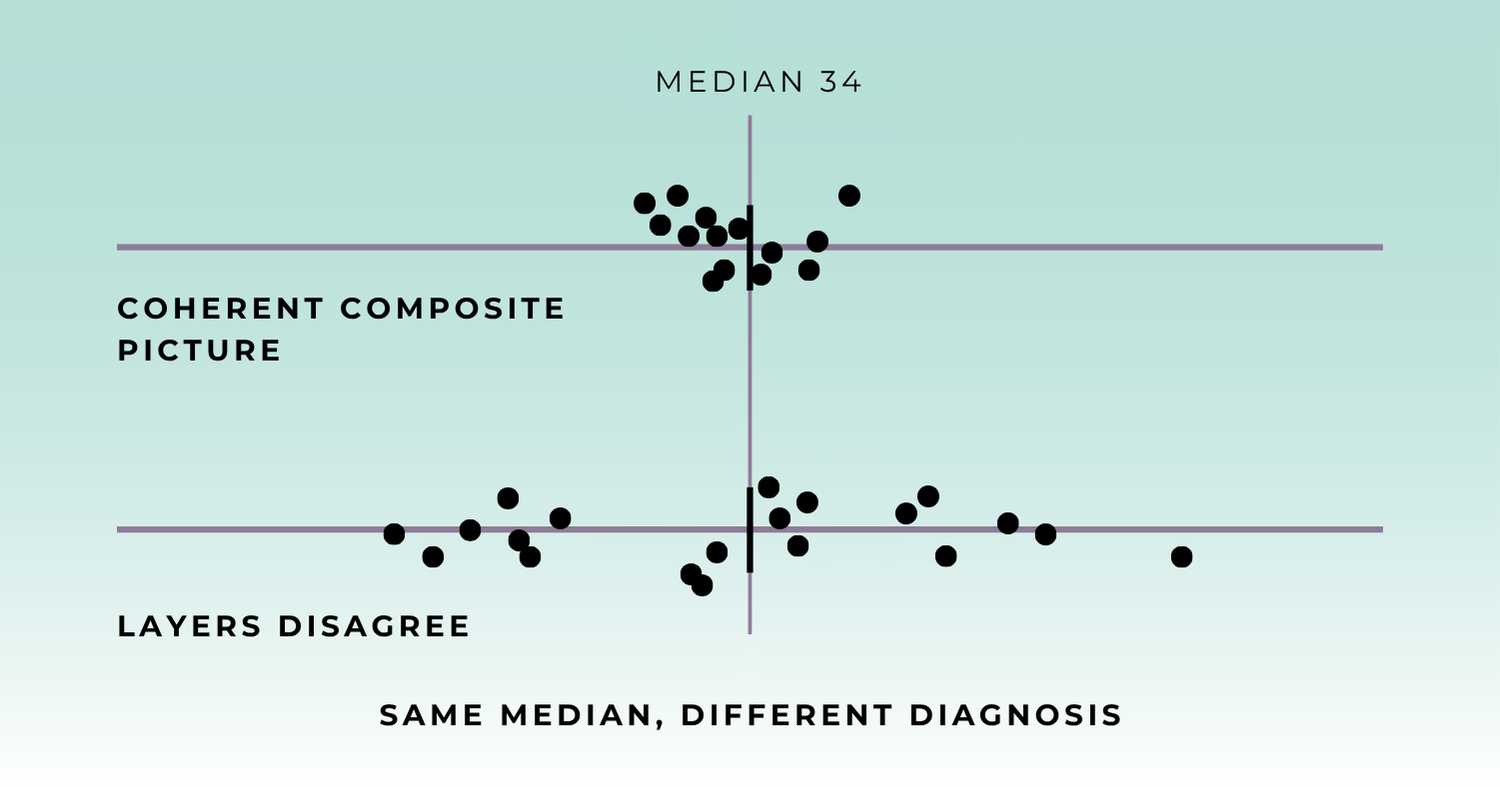
Two brands can share a median of 40 percent and have completely different diagnoses, separated only by spread.
High variance is Authority Debt made visible, because it shows the three layers of evidence disagreeing about what you are.
There is a slide in almost every AI visibility report being sent to clients this quarter. It says something like: your brand appears in 34 percent of relevant AI answers. It is clean, it is trackable, and it gives everyone in the room something to react to. It is also, in a way that is becoming difficult to argue with, not a measurement of anything stable.
Analysis published in Search Engine Land this month makes the case plainly. AI-driven discovery is increasingly personalized, and entity recognition, session context and multimodal signals now shape what a given person sees more than classical ranking position does. If that is right, and it matches what anyone running the same prompt across three accounts already observes, then position has stopped being a property of your brand. It has become a property of the interaction between your brand and one particular person at one particular moment.
A single number cannot describe that. What it can do is describe one draw from a distribution, and present it with a confidence the underlying data does not support.
Why did position stop being a shared fact?
In classical search this problem existed, but at the margins. Personalization adjusted results around the edges while the core ranking stayed broadly consistent, which meant a sentence like "we rank third for that term" carried real information. Two people running the same query mostly saw the same page. The number was a simplification, but an honest one.
That is no longer the arrangement. An AI system does not retrieve a ranked list and hand it over. It assembles an answer, and it assembles it for the person asking, informed by what it already knows about their context, their session, their location, and the entities it has learned to associate with the question. Two buyers with identical needs can receive different names, and neither result is an error. Both are correct outputs of a system designed to personalize.
A single AI visibility score is not a measurement. It is one draw from a distribution nobody has looked at.
What is the machine actually assembling?
Underneath the personalization, the system is doing something consistent. It reads three environments and builds one view. The Structural Layer is the formal record it treats as fact, the registries, knowledge graphs and structured data. The Expert Layer is what credentialed voices say when they discuss your topic. The Community Layer is the unpaid conversation where your buyers actually gather. From these it synthesizes a single working understanding of who you are and what you can be trusted to answer for.
The Composite Picture is the single synthesized view of a brand that an AI system assembles from the Structural Layer, the Expert Layer, and the Community Layer. When those layers agree, the picture is confident and the brand gets named. When they contradict each other, the picture is uncertain and the machine reaches for someone safer.
Personalization does not change what the picture is made of. It changes how much of the picture any one person's query illuminates. A buyer whose context leans technical will pull your brand into view through the Expert Layer. A buyer arriving through a community-shaped question will surface you, or fail to, through what people say about you unprompted. The same brand, read from different angles, produces different answers. The full framework sits on the frameworks page.
What should replace the single score?
The honest replacement is not more precision. It is a sample. Run the question a client would actually ask, across multiple phrasings, multiple personas, and more than one system, then report what came back as a range rather than a point.
Figure
What it tells you
What it replaces
Median
The typical outcome across samples
The old single score, now honestly labeled
Spread
How contested and how stable the position is
Nothing. Almost nobody reports this
Floor
The result on the least favorable phrasing
The optimistic best case in most decks
The spread is the one that changes how you work. A brand appearing in the answer 40 percent of the time with a narrow spread has a coherent Composite Picture and a straightforward volume problem. A brand appearing 40 percent of the time with a wide spread has something more serious: the layers disagree about what it is, so the answer it receives depends heavily on which layer the query happens to touch. Those two brands have identical scores and completely different diagnoses.
Treating variance as noise to be averaged away discards the most diagnostic information in the dataset. Inconsistency is not measurement error. It is the machine telling you, directly, that the record it reads about you does not agree with itself. That is Authority Debt showing up in a form you can act on, and it points at a specific corner rather than a vague instruction to do more.
Authority Debt is the gap between how confidently a brand describes itself and how little independent evidence exists to confirm it. In a personalized system it becomes visible as variance, because inconsistency across the three layers produces unstable answers rather than uniformly poor ones.
It also protects you from the worst failure mode in this category, which is reacting to movement that was never real. A score that moves from 34 to 29 across a fortnight looks like a decline and will be treated as one. If the underlying spread runs from 18 to 52, that movement is indistinguishable from resampling the same unchanged reality. Teams have rebuilt content strategies on less.
Why abandon the number before your competitors do?
There is a commercial argument here as well as a methodological one. Every competitor in this market is currently selling a dashboard with a headline figure on it, because a single number is easy to sell and easy to put in a board pack. Being the one who explains why that figure is unsound, and who replaces it with a range, a spread and a floor, is a credibility position that is difficult to undercut on price.
It is also simply what the evidence now requires. If the system is personalizing, the responsible report says so. Precision that the underlying reality cannot support is not rigour, and clients eventually work out which of their advisers were reporting comfort rather than truth.
A note on the evidence in this article: the claim that personalization now outweighs fixed position is drawn from published industry analysis and from repeated observation, not from a controlled study with access to the systems themselves. Nobody outside these companies can measure the mechanism directly. What can be observed is that identical prompts return different brands for different users, consistently and at scale, and that is sufficient to make single-number reporting unsound regardless of the underlying cause.
Frequently asked questions
Why is a single AI visibility score unreliable?
Because AI answers are personalized. Entity recognition, session context and multimodal signals now shape what a given person sees more than a fixed ranking position does. That makes position a property of the interaction between a brand and one particular person at one moment, rather than a property of the brand. A single number describes one draw from a distribution and presents it with confidence the underlying data does not support.
What should replace a single AI visibility score?
A sampled range with three figures. The median gives the typical outcome. The spread shows how contested and how stable the position is. The floor shows what happens on the least favorable phrasing, which is what a skeptical prospect is likely to encounter. Reporting all three is honest about a system that genuinely varies between users.
What does high variance in AI visibility mean?
High variance usually means the layers of evidence about a brand disagree with each other. The answer a buyer receives then depends heavily on which layer their query happens to touch. Two brands can share an identical median score while one has a coherent Composite Picture and a simple volume problem, and the other has inconsistency across its record. Those are different diagnoses requiring different work.
What is the Composite Picture?
The Composite Picture is the single synthesized view of a brand that an AI system assembles from the Structural Layer, the Expert Layer, and the Community Layer. When those layers agree, the picture is confident and the brand gets named. When they contradict each other, the picture is uncertain and the system reaches for a safer alternative.
How many samples are needed to measure AI visibility properly?
There is no fixed number, but a single prompt run once is never sufficient. Useful sampling varies the phrasing of the question, varies the persona and context of the asker, and repeats across more than one AI system. The goal is enough samples that the shape of the distribution becomes visible rather than a single point that could have come from anywhere within it.
Should I act on a drop in my AI visibility score?
Not without knowing the spread. A score moving from 34 to 29 looks like a decline, but if the underlying spread runs from 18 to 52 then that movement is indistinguishable from resampling the same unchanged reality. Acting on movement inside the noise band introduces changes that will be misattributed later.
Lucy Aingworth is an AI visibility strategist and brand authority consultant, and the author of Become the Answer. She helps founders and CMOs build the authority that AI search actually cites. More about Lucy
Where to start
Measure the spread, not the point.
The Recognition Diagnostic shows you which of the six patterns applies to your brand, and whether your problem is volume or a Composite Picture that disagrees with itself.